

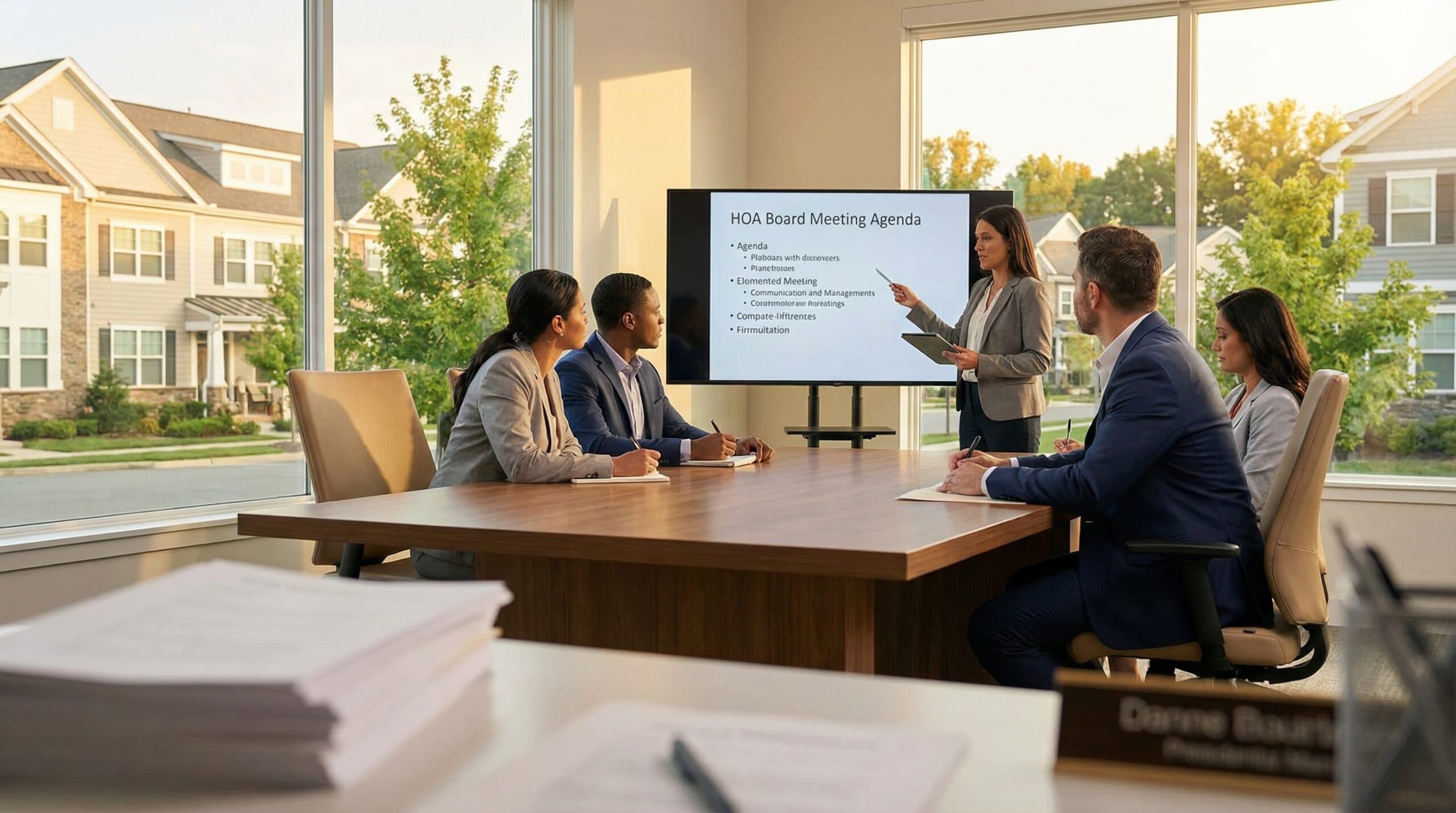
Agenda Planning
The agenda is the meeting. A well-structured agenda keeps discussion focused, ensures important items aren’t skipped, and gives attendees realistic expectations about what will be covered.
Standard agenda structure
- Call to order and quorum verification (1 minute)
- Approval of previous meeting minutes (2-3 minutes)
- Financial report — treasurer or manager presents income/expense vs. budget, reserve balance, delinquency status (10 minutes)
- Management report — open work orders, completed projects, vendor updates (10 minutes)
- Old business — items tabled from previous meetings (time-boxed per item)
- New business — new proposals, vendor approvals, policy changes (time-boxed per item)
- Committee reports — if applicable (5-10 minutes total)
- Open forum / homeowner comments — time-limited (15-20 minutes total)
- Adjournment
Distribute the agenda with supporting documents 3-5 days before the meeting. Board members should arrive having read the materials. Meetings that start with “let me walk you through this document” waste everyone’s time.
Managing Discussion and Decisions
- Time-box agenda items. Assign estimated time to each item. When discussion exceeds the allotment, the president should note the time and ask whether to continue, table for a special session, or assign to a committee.
- One topic at a time. When discussion drifts to unrelated topics, the president should redirect: “That’s an important point. Let’s add it to new business and stay on the current item.”
- Require motions for decisions. Every board action should follow: motion, second, discussion, vote. This structure prevents decisions from being made through discussion without formal approval.
- Record votes individually. Minutes should note who voted for, against, and abstained on each motion. This protects individual board members and provides transparency.
- Don’t relitigate settled issues. Once a vote passes, the board moves forward. Board members who lost a vote should not revisit the topic at every subsequent meeting unless there’s genuinely new information.
Managing Homeowner Participation
Open forum is the most volatile part of any board meeting. Clear rules, applied consistently, keep it productive:
- Time limits: 2-3 minutes per speaker. Use a visible timer.
- Sign-up sheet: Speakers sign up before the meeting begins. This prevents ambush presentations.
- No personal attacks: Comments should address issues, not individuals. The president should immediately redirect personal attacks.
- Questions to the board, not the manager: Homeowners should direct questions to the board as a whole. The president can designate the manager to respond when appropriate.
- Not a decision forum: Open forum is for input, not action. The board should not make decisions in response to open forum comments without proper consideration.
- Follow up in writing: For substantive questions that can’t be answered on the spot, the management company should follow up in writing within 5 business days.
Key Takeaways
- A detailed agenda distributed 3-5 days before the meeting eliminates most meeting dysfunction.
- Limit discussion on each agenda item to 10-15 minutes. If resolution requires more time, table it for a special meeting or committee review.
- Open forum should have clear rules: time limits per speaker, no personal attacks, questions directed to the board as a whole.
- Executive sessions should be rare and limited to topics legally permitted in closed session (litigation, personnel, delinquencies).